Quick answer: under 13-card Indian Rummy rules, each player gets 13 cards and tries to arrange all of them into valid groups. A winning hand must have at least two sequences, and one of them must be a pure sequence (no joker). The remaining cards can be sequences or sets. The first player to declare a valid hand wins the round.
How is the game set up?
- Players: 2 to 6.
- Cards: one or two standard 52-card decks, depending on the number of players, plus printed jokers.
- Deal: 13 cards each. The rest form the closed deck, and one card is turned face up to start the open pile.
- Wild joker: one card is chosen at random. Every card of that rank, in every suit, becomes a joker for the game.
13-card Indian Rummy rules for sequences and sets
| Group | Rule | Example |
|---|---|---|
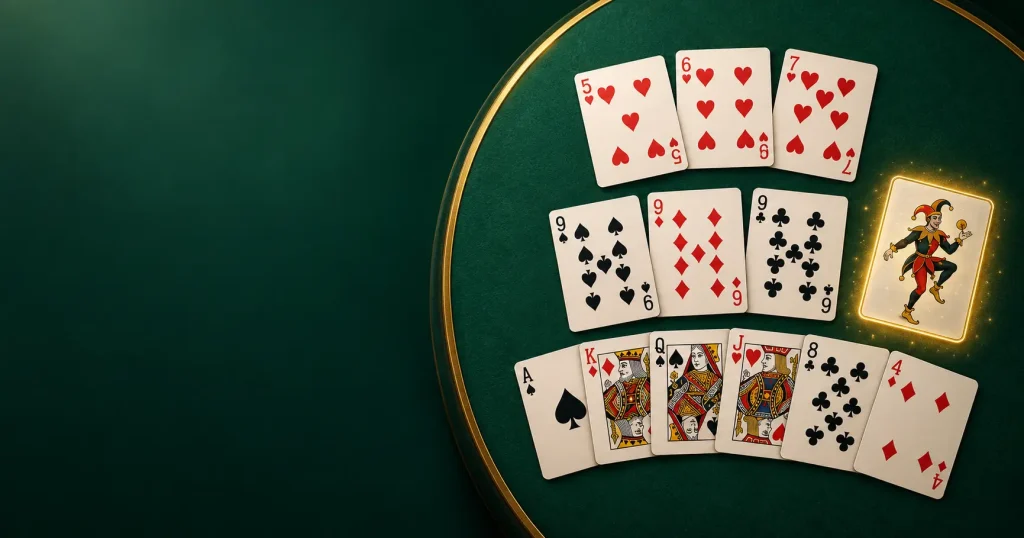
| Pure sequence | 3 or more consecutive cards of the same suit, with no joker | 5♥ 6♥ 7♥ |
| Impure sequence | 3 or more consecutive cards of the same suit, using a joker in place of a card | 5♥ 6♥ joker 8♥ |
| Set | 3 or 4 cards of the same rank in different suits; jokers allowed | 9♠ 9♦ 9♣ |
An ace can be low (A-2-3) or high (Q-K-A), but a sequence cannot wrap around (K-A-2 is not valid). A set cannot contain two cards of the same suit.
How does a turn work?
- Pick one card, either from the closed deck or the top of the open pile.
- Discard one card onto the open pile.
When your 13 cards form a valid hand, you pick your 14th card, discard it to the “finish” slot and declare. Your groups are then checked: an invalid declaration is penalised.
How are points counted?
Points count against you, so lower is better. When someone declares, the other players count the cards that aren’t in valid groups:
- A, K, Q and J: 10 points each
- Number cards: their face value (7 = 7 points)
- Jokers: 0 points
Most online tables use these penalties: a first drop (leaving before your first turn) costs 20 points, a middle drop costs 40, the maximum loss in a round is 80, and a wrong declaration costs 80. Values can differ by table, so check the rules before you play.
What are Points, Pool and Deals rummy?
- Points Rummy: a single deal. Each point has a set value, and the loser’s points decide what the winner earns.
- Pool Rummy: players are eliminated when their points reach a limit, usually 101 or 201. The last player left wins.
- Deals Rummy: a fixed number of deals. Players start with chips, and the one with the most chips at the end wins.
Tips for learning the 13-card Indian Rummy rules
- Build your pure sequence first: without it, you can’t declare.
- Throw away high cards you can’t use early, to cut your points if you lose.
- Watch what other players pick from the open pile.
- Don’t hold on to jokers for impure sequences before you have a pure one.
For an overview of rummy and its variants, see About Rummy, or read about the wider family of games on Wikipedia. Note that the apps listed under Rummy-Named Apps don’t include rummy game files in their APKs; see each game page for details.